Blog

Dino track found on Mount Pelmo at 3000 mt

Un'impronta

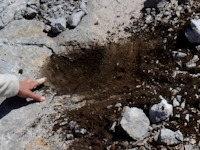
Mount Pelmo, Dolomiti. North-east ridge, 3025 meters (about 9925 feet) above sea level. Last September a group of five speleologists and mountaineers of La Venta Association spotted a possible track of dinosaur footprints, among the highest in Europe.
Mauro “Lampo” Olivotto, known sculptor and mountaineer from the Cadore area, author of the sculptures known as “Giauli”, is the promoter of an extravagant mission suspended among art, mountaineering and poetry: reaching a big cave that opens in the middle of a wall of Mount Pelmo and casting a photographic set for his wooden characters. The enterprise was accomplished on 10th and 11th September 2011 thank to four speleologists and mountaineers of La Venta Association of Geographical Explorations. The exploration required setting a little camp on the north-east ridge of Mount Pelmo, which allowed the necessary time to let themselves down the cavity, named Giauli Cave. The descent of over 150 meters (ab. 500 feet) on a wall of almost 1000 (ab. 3300) was equipped by speleologist Antonio De Vivo from Treviso.
Read more: Dino track found on Mount Pelmo at 3000 mt

To top it all

4“It's always like this - says Cesco at the phone - the best things come at the end”.

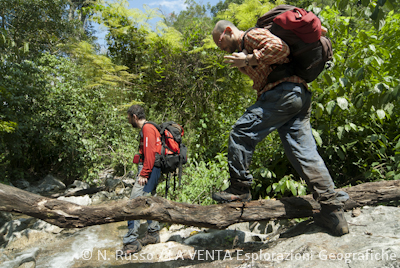
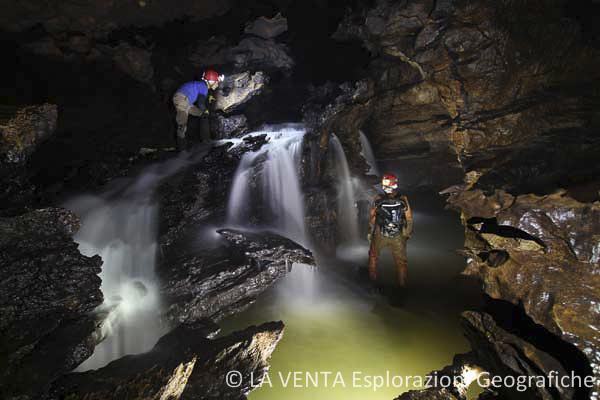
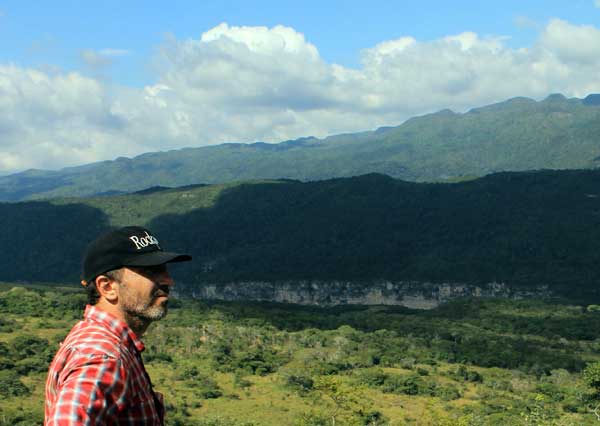
The Chiapas expedition is almost over and, as usual, the best explorations were made in the last three day. The Cueva del Convento, found last April thank to some indication of the inhabitants of La Florida colony, has begun to reveal its potential. Just yesterday were explored two high entrances (Ojos de Zapote) that lead directly in a big gallery crossed by a river. Here we walked down 1 km, to a syphon; and 2 km up, where the cave, as we can literally say, close on black: gallery, and then gallery again. It continues indeed.

Read more: To top it all

Sixteen kilometers in sixteen years

Click to enlarge

You are right: not even a snail could take long. However...sometimes life is slower than a snail, but also stranger. It happens, sometimes, that you come back many years after in a place where you have already been. But it has never, before now, transmitted to me feelings so different from the ones feeled normally in an expedition. Sixteen years. As much the years I haven't seen the walls of Rio La Venta canyon. Sixteen years. Many for a human being. Very few for those walls, for the wood above, for the water that cross them.

Read more: Sixteen kilometers in sixteen years

Last developments from Chiapas

Click to enlarge

New satellite phone call from Chiapas expedition, almost over. All is going fine, down in the forest. The speleology course went well, with fifteen young pupils, excited and motivated. Tullio gave a lesson to 300 college students of the Instituto Tecnologico of Cintalapa, and they are now really interested in speleology.

Last week three groups carried out the explorative front: one at the rancho El Arco, Los Joaquines Colony, to verify new indications; one in the Nueva Jerusalèn Colony, over Carranza, where they have been very well welcomed and are verifying many new entrances; the third at the Florida Colony, already visited in April, where was found the high entrance to Cueva del Convento, that leads in a big active gallery. It was explored for over 1 km. And it continues.

Read more: Last developments from Chiapas

Oggiscienza interviews Leonardo Piccini

From yesterday is online on the Oggiscienza site the interview by Federica Sgorbissa to our partner Leonardo Piccini.

logo-ospodcast

The topic is geographical exploration in this millennium. You can also listen to the podcast on the site www.oggiscienza.it at this link.

Coming back to Sciacca.

Here we are again.

We have come back to Sciacca, in the wonderful Sicily, with the friendly speleologists of the Eugenio Boegan Commission from Trieste. We share with them joys and pains of this project: the Kronio Project.

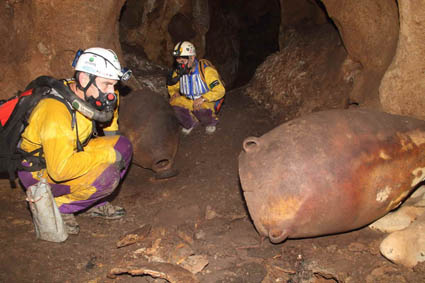
Pithoi di Kronio Click to enlarge

The scenery is the Stufe di S. Calogero, a network of thermal caves that opens at the core of Mount Kronio, dominating Sciacca.

Part of these days was dedicated to the meetings with the local institutions and with the Soprintendenza ai Beni Culturali of Agrigento, that have consented the beginning of the project.

If you did not know that, the Stufe di S. Calogero is also an archeological site. Inside this cave, that opens in the thermal establishment of the city, at a depth of 40 meters, they found some big vases (Pithoi) dating back to an age from 4000 to 2000 B. C.

Read more: Coming back to Sciacca.

Questo sito o gli strumenti terzi da questo utilizzati si avvalgono di cookie necessari al funzionamento ed utili alle finalità illustrate nella cookie policy. Se vuoi saperne di più o negare il consenso a tutti o ad alcuni cookie, consulta la cookie policy. Cookie policy