- Details
-
Created: Saturday, 02 March 2013 15:51
-
Published: Saturday, 02 March 2013 15:51
-
Hits: 10784
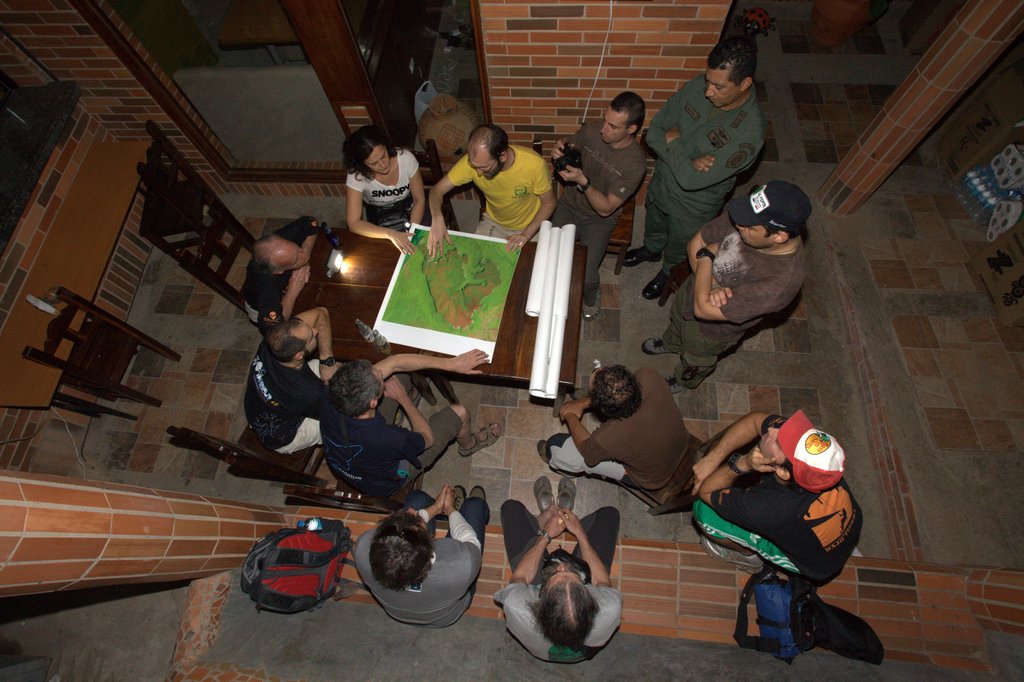
The following is the press release we announced the launch of a new expedition on Venezuelan Tepui. After that, from the start, we will post the news that will come directly from the field.
«The 27th of February began a new expedition of the Association La Venta in Venezuelan land. The expedition represents a new step of "Project Tepui", promoted and organized by La Venta, a nonprofit group that from twenty years carries out multidisciplinary research around the world, mainly in the underground, and which has currently organized more than sixty expeditions in many remote regions of the Earth: from Antarctica to Patagonia, from Myanmar to Mexico, from Central Asia to Venezuela.
Tepui is a word of Pemon origins, a group of indigenous peoples of the north of the Amazon, and means "house of the spirits" or "house of the gods", and is used to indicate the high mountains that rise to the northeast of the Amazon rainforest, in the area called Gran Sabana, on the border between Venezuela, Brazil and Guyana. Are very particoular mountains: their shape is squared, with large summits surfaces bounded by vertical walls. In the areas where erosion has been more intensive, some have the form of isolated towers, up to 1000 m high. These mountains mainly consist of quartz sandstones deposited in a large area between South America and Africa, about 2 billion years ago, when the two continents were still united.
These majestic and isolated plateaus were inspired Arthur Conan Doyle's Lost World, and, more recently, the cartoonists of Pixar in the realization of the animated film “Up”.
This is an area that has become accessible to Western man only by a few decades and, because of the considerable difficulty of approach, can actually be considered as still almost completely unexplored.
The group La Venta has organized the first expeditions in this area in the 90s, especially in the Auyan-tepui, and then expanded the research to Chimantha-tepui and to Roraima. Against few and extremely difficult expeditions, the scientific results have been remarkable, with the discovery of important caves that contain peculiar minerals and bio-mineral formations of silica, similar to stromatolites, which probably represent relicts of ancient bacterial colonies of hundreds of thousands of years old. Several studies are under way as part of the project by the University of Bologna, University of Modena, University of Florence and ETH of Zurich.
The area subject of research during this year's expedition will be the Auyan-tepui, known for hosting the highest waterfall in the world, the Salto Angel (or Kerepakupai Merù in indigenous language), 970 meters high. This mountain was also the scene of a attempt of exploration by Walter Bonatti, in the 1967, reported in the book "In distant lands".
The main objective of the group of cavers is to reach some caves which open on the eastern wall of the mountain, suspended nearly a thousand meters above the surrounding plain.
The team, led by Paduan geologist Francesco Sauro and by the caver-mountaineer from Treviso Antonio De Vivo, consists of cavers, geologists, cameramen and photographers, from various regions of Italy, with cavers from Venezuelan Teraphosa Exploing Team of Puerto Ordaz.
The expedition is sponsored by the Ambassador of the Bolivarian Republic of Venezuela in Italy, Dolomiti UNESCO Foundation, Italian Speleological Society, CONI Veneto, Central Commission for the Speleology CAI.
The project is supported by the Company Geotec SPA and by following technical partners, Dolomite, Intermatica, Ferrino, Amphibious, De Walt, Allemano Metrology, Chelab, Scurion, MountainHouse.»
Read more: Back on Tepui!


 Good news from the Tepui. The "Sima del Viento" is proving to be a huge monster. In just three days were topographed 5 and a half kilometers and explored over 10. All this, in addition to being detected, was photographed and taken up in video. But, more importantly, we are producing a huge scientific documentation that will take a long way back to study the data.
 Anche quest'anno si è svolta a Trieste la rassegna di cinema, arte e cultura della montagna che dall'anno scorso vede anche un concorso dedicato alla speleologia. 12 i filmati speleo presentati.