The gigantic estuary of the Congo River, one of the largest in the world, with its powerful jet of debris, earth and trees, transforms the ocean into a murky soup for hundreds of kilometers and marks the border between the cities of Brazzaville and Kinshasa, respectively the capitals of the Republic of Congo and the Democratic Republic of Congo.
Moving southwest from chaotic Kinshasa, whose arteries are perpetually clogged by a continuous movement of people, vehicles and improvised markets, you cross the Central Congo region and reach the city of Mbanza Ngungu.
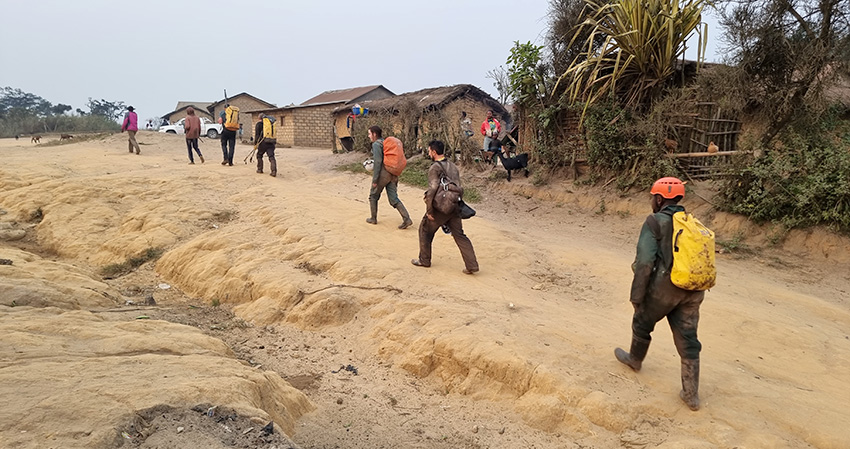
Starting from this quiet town, approaching the border with Angola, a hilly karst area develops characterized by imposing sinkholes surrounded by thick bamboo and springs that feed fields of cassava and banana trees.
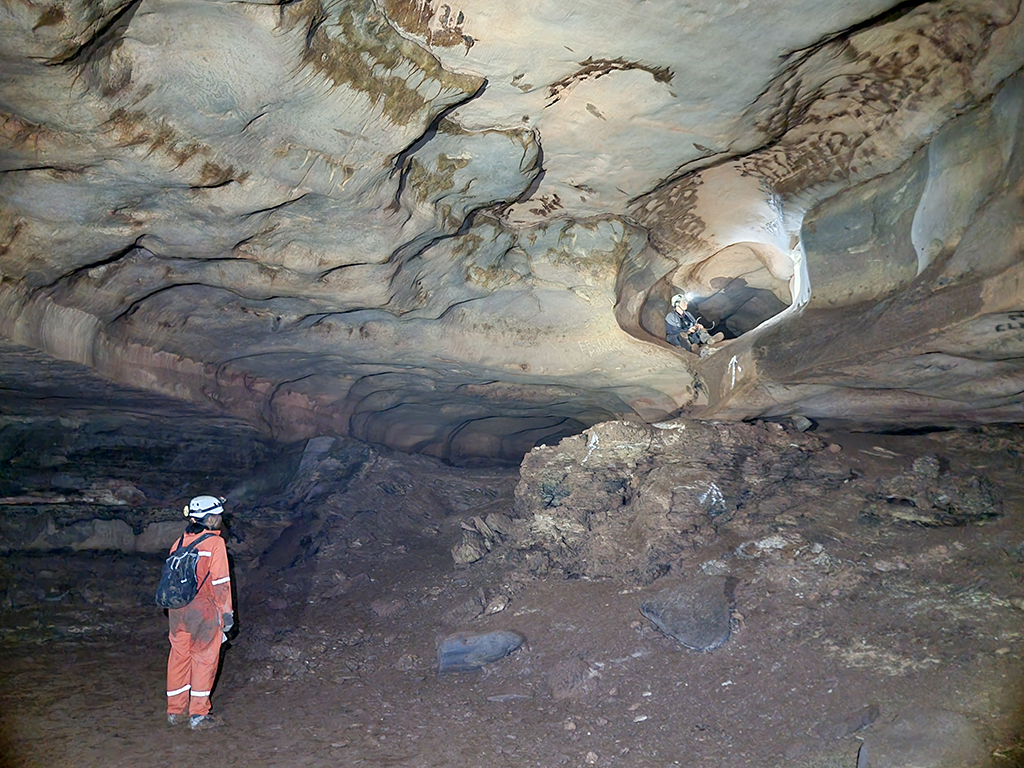
Access points between the rocks, perhaps the oldest on the planet, which lead to cave systems where underground rivers often flow darkly, alternating with large fossil galleries that testify to ancient human presence.
In this fascinating landscape typical of central Africa, the GeoRes4Dev project coordinated by the Royal Belgian Museum of Central Africa (RMCA) in Tervuren, since 2019, has aimed to contribute to the development of the skills of students and doctoral students, creating a scientific basis for the creation of Geoparks with the support of UNESCO.
This project, in addition to the Democratic Republic of the Congo, is also being developed in the Republic of the Congo and Burundi.
During the first two expeditions carried out in the DRC in 2023 and 2024, carried out with the support of the Geological and Mineralogical Research Centre (CGRM) in Kinshasa, the main cavities of this fascinating karst area were reviewed and mapped for about 20 km, opening up significant exploratory prospects for the future of the project.
Among these, it is worth highlighting the important discoveries made in the Ngovo-Ngungi system which, thanks to the connections made in 2024, has reached a development of about 10 km, thus becoming the thirteenth cavity in the African continent by extension.
Since 2024, the La Venta team has also contributed to the GeoRes4Dev project by providing technical support and two expeditions are planned for 2025.
In fact, a new expedition will take place in the Mbanza Ngungu area from 24 June to 8 July. The main objective of this mission will be documentary and will see the specialists of the Association of Geographical Explorations La Venta create a first video and photographic contribution of the project underway in this fascinating province of the Democratic Republic of the Congo. At the same time, scientific, exploratory and mapping activities of the other cavities present in the area will also be carried out.
In September, the first expedition will be carried out in the karst forest of Bangu, a region located about 100 km northwest of Brazzaville, in the Republic of the Congo. This first expedition follows an initial survey of the GeoRes4Dev project carried out in 2019, during which significant cavities were reported.
Giuseppe Spitaleri