 This work has attracted the attention of the media, including the BBC, who has decided to shoot a documentary on the Auyan Tepui and the Imawarí Yeuta cave. So we have come once again down here, among these amazing mountains, to work together with a crew of documentary filmmakers.
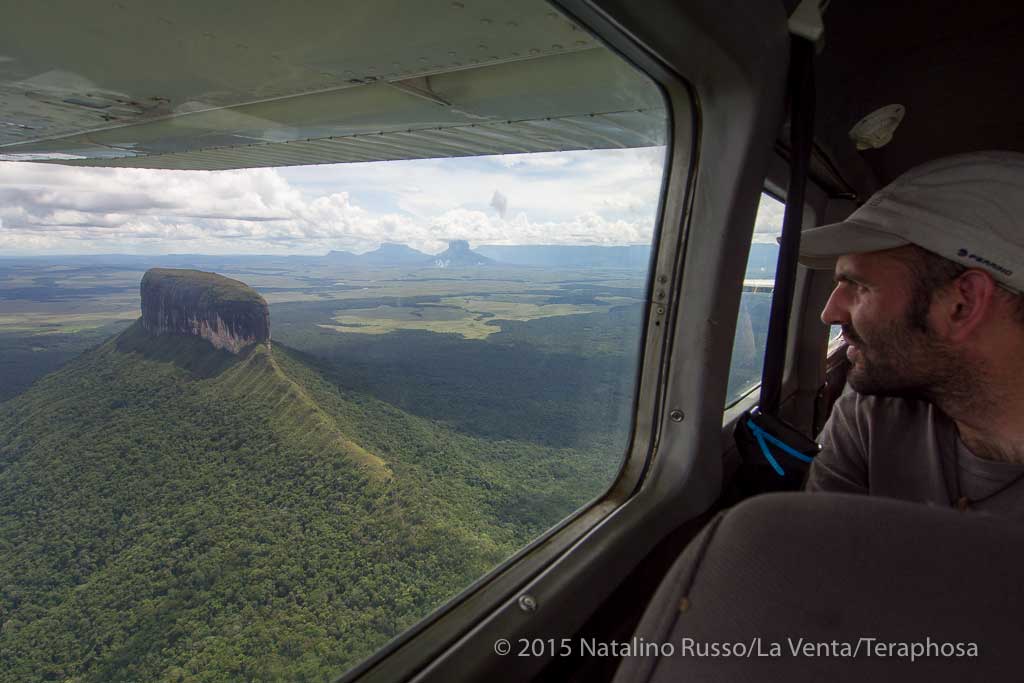
Two flights until the sultriness of Manaus, one on the forest and the majestic Amazonian rivers to Boa Vista, then by land through the Brazil-Venezuelan border, a few days in Santa Elena de Uairen for shopping and organizing the logistics, finally on the Cessna over the savannah to the tiny village of Kavac, at the southern foot of the Auyan.
This work has attracted the attention of the media, including the BBC, who has decided to shoot a documentary on the Auyan Tepui and the Imawarí Yeuta cave. So we have come once again down here, among these amazing mountains, to work together with a crew of documentary filmmakers.
Two flights until the sultriness of Manaus, one on the forest and the majestic Amazonian rivers to Boa Vista, then by land through the Brazil-Venezuelan border, a few days in Santa Elena de Uairen for shopping and organizing the logistics, finally on the Cessna over the savannah to the tiny village of Kavac, at the southern foot of the Auyan.
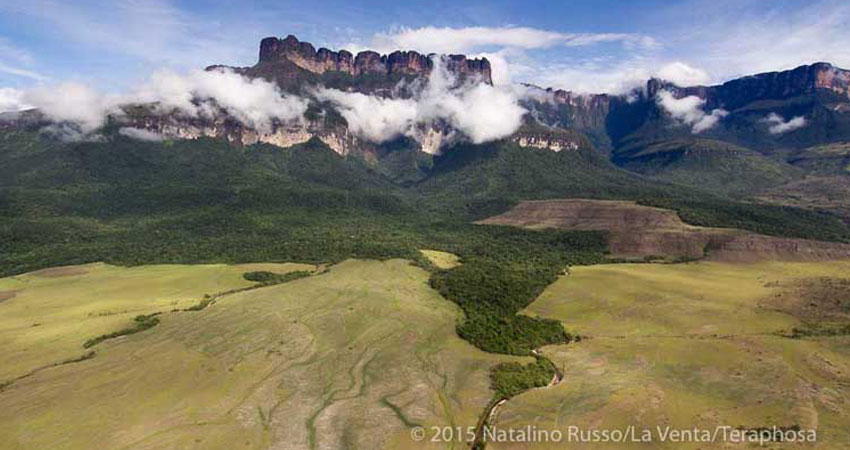
The Tepui, over two thousand meters high, looms over the village with its imposing walls. It is a colossal fortress and perennial clouds make it even more impregnable. Here there are no roads or paths, you travel only by helicopter or small planes.
Raul, the pilot, is already ready at dawn. The sky promises to be open for a few minutes, so the helicopter catapults us to the top plateau. And, beating its blades, it disappears in the fog.
Time Machine. Silence. We are alone, with our backpacks and equipment to explore, the food supply and a mobile satellite phone. And the tents to put up before it starts to rain. All around dark quartzite, swamps, carnivorous plants. Fog. Time. Millions of years envelop us in an intimate atmosphere. The moisture gets into our bones. In addition, somewhere, a thousand waterfalls crash into the depths of the Tepui.
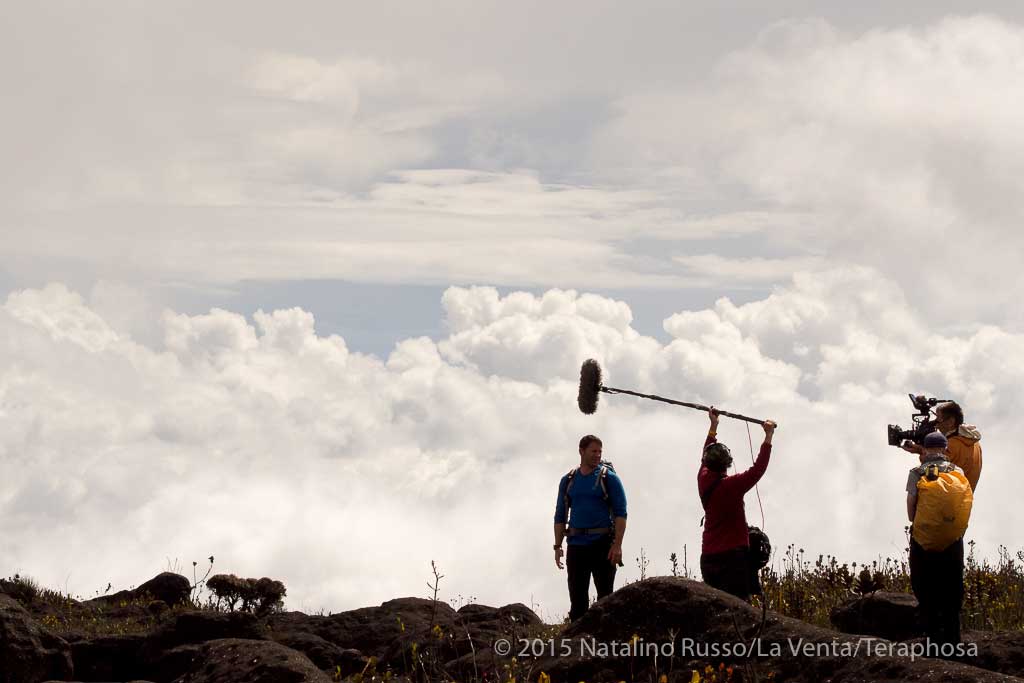 Our base camp is located right on the edge of the Sima del Viento, the great chasm where opens Imawarí Yeuta. Seven tents for us and the crew, fourteen people, plus two large tents for the kitchen and the warehouse. Welcome to the Grand Hotel Auyantepui. Here you will find luxury toiletries and dark dreams.
We spread a yellow ribbon to signal the paths to follow and to avoid any damage to the vegetation: here you go to the bathroom (at the end we will bring our stuff with us), beyond the stream you can wash, there you descend into the Sima. And we do the same in the Cave: yellow ribbon not to go where we have not already put our feet while exploring, bags where to deposit our poo. We want to leave as fewer footprints as possible, we will steal only pictures, we will kill only time, if we will be able to grab it.
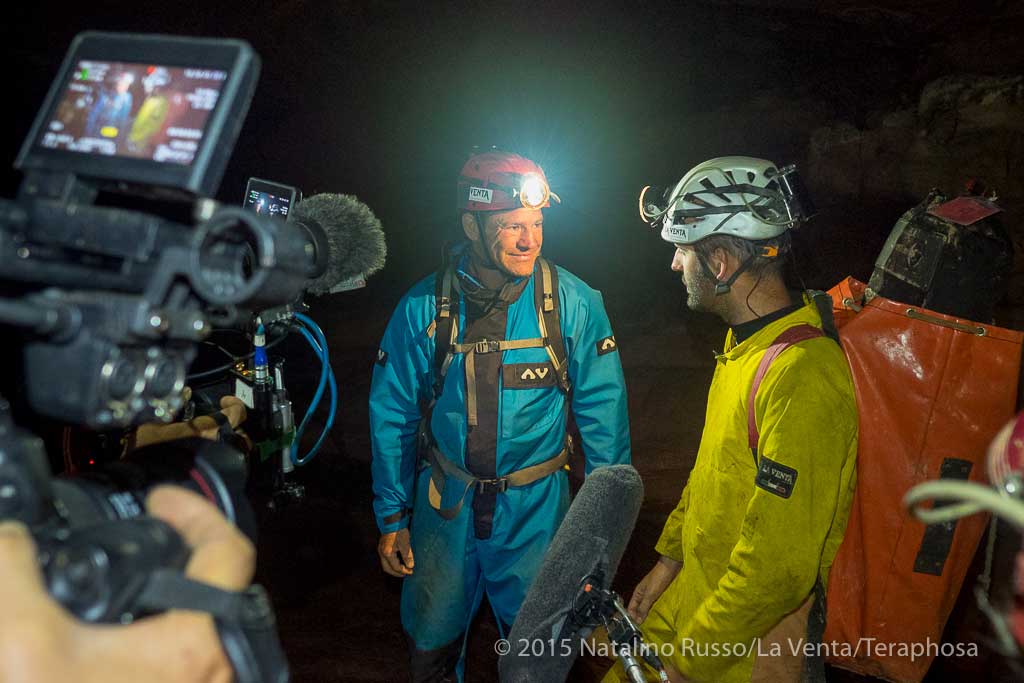
The guys of the crew, too, are put to work immediately. Andrew, the sound engineer, puts his headphones on and, like a bloodhound, he chases with his big microphone the sounds of the Auyan. Keith and Hugh, the two operators, put up easels, change the objectives, study the shots. Ben, the director, takes notes. Steve, the presenter , has the opportunity to give a final look at the script. Max, the production assistant, shakes, writes, fiddles nervously with the satellite phone. Aldo is the angel guardian of the crew: the BBC has sent him to check that no one of them gets hurt.
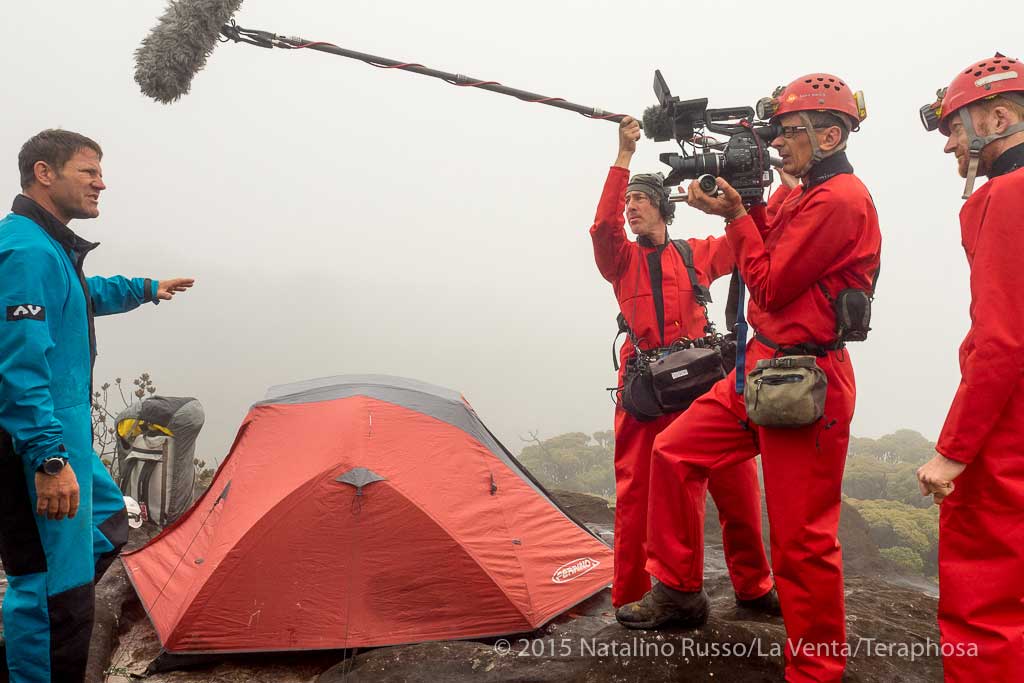 Silence. Action.
«Action!!» shouts Ben.
Steve walks among the tents, then he goes among the heliamphores and the fog with his feet in the marsh, followed by the operators and the sound engineer. Then he looks into the hall, he opens his arms: "Wow! – he says with a smile - This place is absolutely amazing".
At the base camp it begins to rain. Then the sun comes out and burns our skin. It's raining again, this time in bursts. It will continue throughout the evening and night. Wet sleep, long dreams.
The rain turns into waterfalls the walls of the Sima del Viento. But we soon get used to it. The air is saturated with droplets but we can still breathe. Perhaps we have developed some kind of gills. After a few hours we have also get accustomed to the slimy rocks and the vegetation, stinging and dropping a lot of water. It is beautiful, with its bright green. We take down the material of the BBC with a cableway, we equip with ropes the more slippery stretch, we rig the initial pits of the cave, we settle an internal camp to prevent the crew to go up and down the landslide. So finally we move into the cave: there will be four uninterrupted days of shooting, we will sleep on an underground bank, next to the river. A wet spot, but drier than the base camp outside.
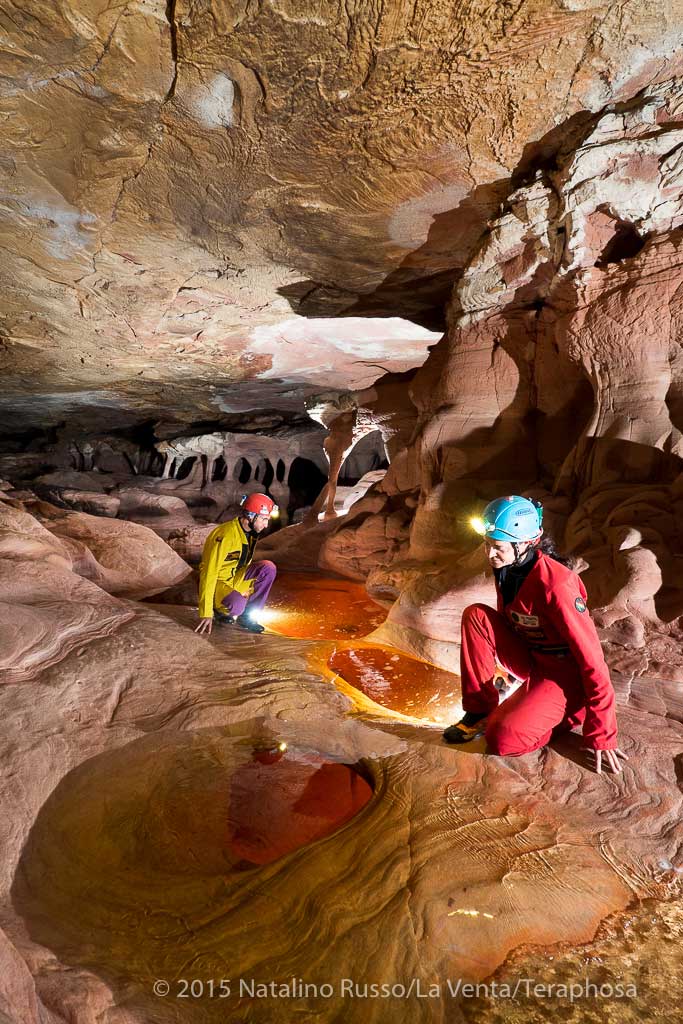
 One by one we go through different branches of this immense, beautiful cave. Imawarí Yeuta means 'the cave of the gods', in the Pemon language. A fully deserved name. Its exploration is a journey through huge galleries, between slender columns modeled by erosion, floors streaked with pink, purple and red, concretions of opal, gypsum crystals on the edges of blocks sharp like glass, cyclopean landslides, salons hundreds of meters long, colorful lakes and bizarre formations, nests of the guácharos, sudden openings to the outside, the sunlight, the smell of green moss, hummingbirds flying curious, and then again the dark, the cave, the river, rapids and bends with sandy banks. And the great waterfall of Rato, a dream place. If the Leprechauns exists, they lives there.
The boys of the crew are ecstatic, they stop every few meters to shoot some scenes.
One by one we go through different branches of this immense, beautiful cave. Imawarí Yeuta means 'the cave of the gods', in the Pemon language. A fully deserved name. Its exploration is a journey through huge galleries, between slender columns modeled by erosion, floors streaked with pink, purple and red, concretions of opal, gypsum crystals on the edges of blocks sharp like glass, cyclopean landslides, salons hundreds of meters long, colorful lakes and bizarre formations, nests of the guácharos, sudden openings to the outside, the sunlight, the smell of green moss, hummingbirds flying curious, and then again the dark, the cave, the river, rapids and bends with sandy banks. And the great waterfall of Rato, a dream place. If the Leprechauns exists, they lives there.
The boys of the crew are ecstatic, they stop every few meters to shoot some scenes.
"Action!" Shouts the director.
"Wow! - Follows precise the presenter - This place is incredibly huge".
Meanwhile, we can also explore a couple of small new branches, to collect water samples and expand our video and photographic documentation.
 In the evening, after ten hours of work, we return slowly to the internal camp. A nice amount of freeze-dried food, tea, hot chocolate and rum are awaiting us. And the restorative hug of our sleeping bag. It is nice, camping in Imawarí. Even when outside it's raining, the river level does not rise that much. Good night, then. Sweet dreams.
And if instead of raining heavily, it rains very heavily?
In the evening, after ten hours of work, we return slowly to the internal camp. A nice amount of freeze-dried food, tea, hot chocolate and rum are awaiting us. And the restorative hug of our sleeping bag. It is nice, camping in Imawarí. Even when outside it's raining, the river level does not rise that much. Good night, then. Sweet dreams.
And if instead of raining heavily, it rains very heavily?
We find it out the last night, when the noise of the flood knocks at our sleep. We light the lamps and, oops, in a few minutes the water has come to lap the sleeping bags. The quiet stream has turned into a rushing river. Outside it must be raining very heavily Half awake, cold and sleepy, we look at the water level. Will it continue to rise? or will it drop? A yawn. Drowsiness is stronger than fear. A chill. Reluctantly we transfer all the video material in a safe place, and then we drag our mats and sleeping bags to the highest part of the bank. May god help us. Sweet dreams, good night.
What a night.
Underground the dawn concerns only the clock, not the eyes. Dark. Wet. We would like to sleep more than ten, twelve hours. But now the work is finished, it's up to transport all the material out of the cave, then up the slippery rocks of the landslide, and to reach slowly the base camp. Hoping it’s not raining again, because if it is cloudy or foggy the helicopter cannot come to rescue us.
Up here, there are nearly five millimeters per year, and the sky is always covered. When a window of blue opens up, the sun is hot, but it lasts a few minutes. It is hot, and a moment later it’s raining. Then it stops, a thick fog raises and goodbye helicopter... A Tepui is a place infinitely far. It's easy to get stuck for days.
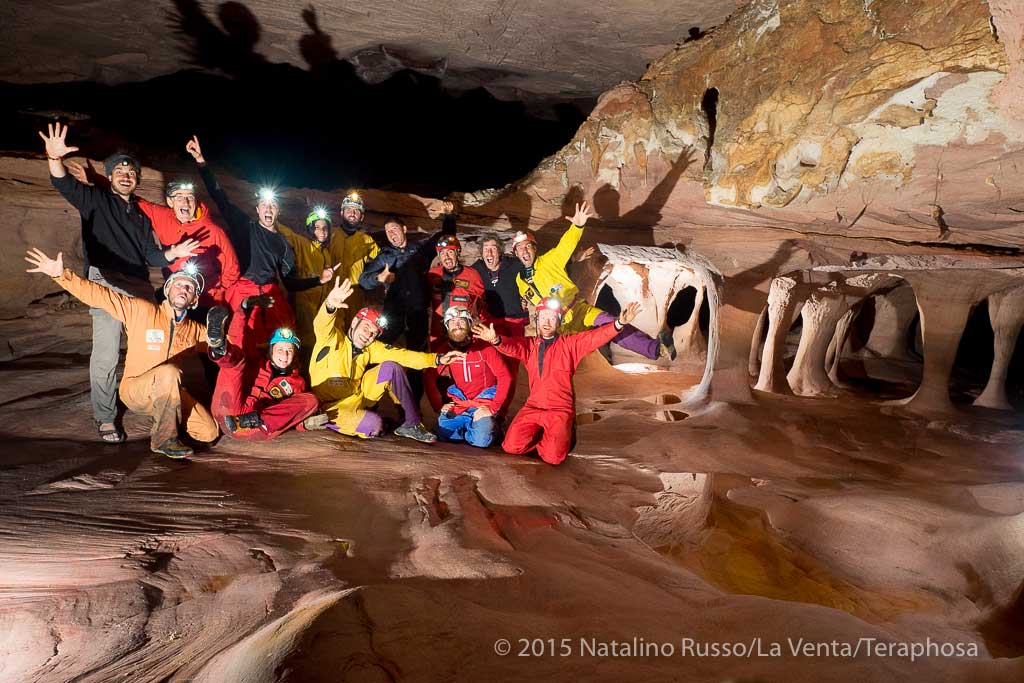 But the Italian Meteorological Society has given us detailed weather reports, sending them to our satellite phone. So we are optimistic. Look up. Clouds They run, open and close the sky. Waiting. Fingers crossed. After more than a week in the mists and in the marshes of the Grand Hotel Auyantepui we cannot wait to dive into the river of Kavac. We already anticipate a nice dinner and a cold beer and rum, and toasts and hugs and ideas, those you say to laugh and then become future projects. The clouds run, the sky opens and closes again. Then finally comes the expected window. A large patch of blue. Maybe it will last an hour. And here it is the helicopter, already buzzing over our heads, ready to bring us back to the valley. We are happy to return to the comforts.
But no: once again we will travel home with wet eyes and a lump in our throats, loaded with pictures and stories. We will try to tell them, trying not to let them fade away.
Natalino Russo
ACKNOWLEDGEMENTS AND PARTICIPANTS
But the Italian Meteorological Society has given us detailed weather reports, sending them to our satellite phone. So we are optimistic. Look up. Clouds They run, open and close the sky. Waiting. Fingers crossed. After more than a week in the mists and in the marshes of the Grand Hotel Auyantepui we cannot wait to dive into the river of Kavac. We already anticipate a nice dinner and a cold beer and rum, and toasts and hugs and ideas, those you say to laugh and then become future projects. The clouds run, the sky opens and closes again. Then finally comes the expected window. A large patch of blue. Maybe it will last an hour. And here it is the helicopter, already buzzing over our heads, ready to bring us back to the valley. We are happy to return to the comforts.
But no: once again we will travel home with wet eyes and a lump in our throats, loaded with pictures and stories. We will try to tell them, trying not to let them fade away.
Natalino Russo
ACKNOWLEDGEMENTS AND PARTICIPANTS
We are thankful to the Pemón community of Kavak and Kamarata for the hospitality and support in this project; and to the Italian Metereological Society for the daily weather forecast.
This work has been possible thanks to the collaboration of: Rolex, Dolomite, BEE1, De Walt, Ferrino, Geotec, Scurion, Amphibious, Intermatica, Mountain House.
The logistics has been carried out by La Venta Association (Francesco Sauro, Francesco Lo Mastro, Carla Corongiu, Vittorio Crobu and Natalino Russo, with the collaboration of Daniela Barbieri) and by the Theraposa team (Freddy Vergara, Jesús Vergara, Lenin Vargas).
The BBC crew included Ben Lawrie (director), Max Goldzweig (production assistant), Steve Backshall (presenter), Keith Partridge (cameraman), Andrew Yarme (sound engineer), Hugh Campbell (second camera) and Aldo Kane (safety manager).
The flights on Cessna and helicopter have been performed by the Raul Helicópteros Society with the collaboration of Raul Arias and Karina Ratzevicius.