Blog

Scanning in salt

Friday, November 20, 2015.
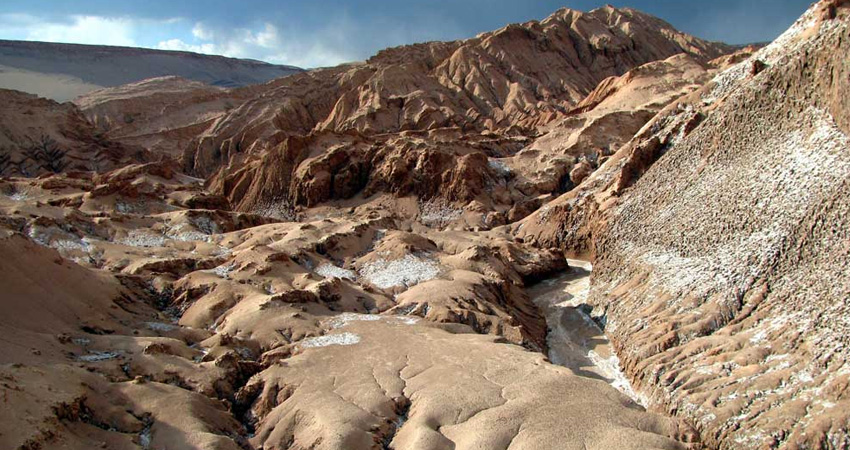
Today is our first day in Chile operating with the full team. We plan a visit to one of the simplest and nearest caves in San Pedro, the Cueva de Chulacao. It is a cave about 1 km long, characterized by a wide variety of environments: about 2 meters wide meandering tunnels, passages in salt even more than 10 meters, access shafts (skylight), conduct also more narrow, and a large collapse hall.
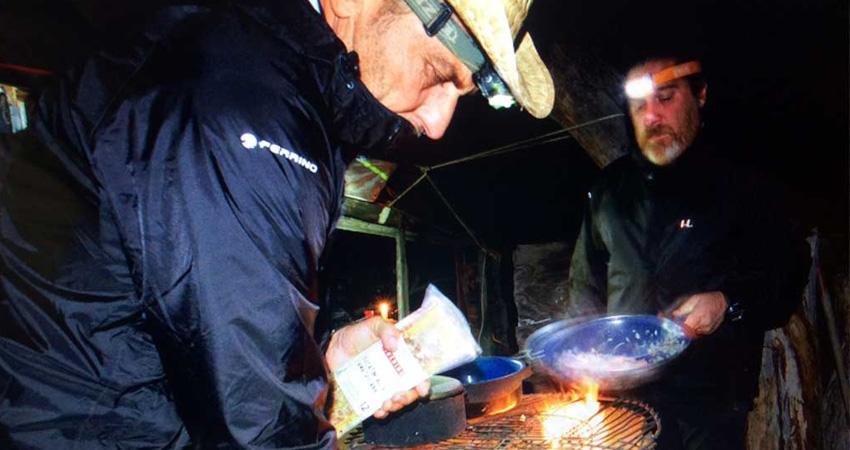
This cavity is an ideal training ground for practicing in the strange forms of the caves in the salt, but also to test the Leica HDS7000, the precious technological instrument kindly provided by the company Gruppo Servizi Topografici (G.S.T. snc) of Reggio Emilia. The exceptional rains of last March more than the plains of Atacama did also flourish this cave with the formation of white eccentric made of salt. In some areas of the cave is possible to observe the level reached by the underground river, up to 5 or 6 meters above the ground level. The cave walls are literally plastered with plant remains transported by water, but also from a new form of underground deposition consists of small millimetric white balls: the “paleoystyrene”. In fact, the recent flood has also drained the modern (in)civilization materials. The floor is entirely covered with a layer of salt that looks like carasau bread, while in various corners have grown even half a meter long stalactites. Looking in detail on the walls and on the stalactites have grown very white hair extremely fragile, even a few centimeters long. Our photographers have indulged more than the bizarre concretions, making a painstaking work to capture as much detail as possible of this crystalline world. _09At the same time a team has been dedicated to the acquisition using the laser scanner, experiencing very detailed scans, sequences of measures in line, in areas from a few meters to the great hall of collapse, with the aim to test the durability of the batteries and the real potential of this technique in describing the underground areas. Jo De Waele The expedition is sponsored by the Italian Speleological Society, and has the support of the Gruppo Servizi Topografici (GST snc) of Reggio Emilia (laser scanner), and of Intermatica (Satellite telephony), Ferrino (Clothing and outdoor equipment), Dolomite (mountain shoes), Amphibious (Dry bags), Scurion (lighting LEDs), Tiberino (freeze-dried foods ready to cook). Participate for La Venta: Jo De Waele, Riccardo De Luca, Umberto Del Vecchio, Marco Mecchia, Fulvio Iorio, Alfredo Brunetti, Laura Sanna, Andrea Cabras, Roberto Ferrara, Norma Damiano, Marco Vattano.
Read more: Scanning in salt

On the way home from Baja California

Wednesday 18. We have the horses. Finally we advanced more in the immense territory of the Sierra de la Asamblea.
We rode for more than 4 hours following the dry channel of an ancient river. The route, after an hour's journey in open territory, was increasingly earning between two overhanging cliffs. All around the cactus "Cardon" and shrubs of "mesquite" hindered the march of our horses. After two more hours we reached the confluence with the arrival of la Asamblea, another ghost watercourse.

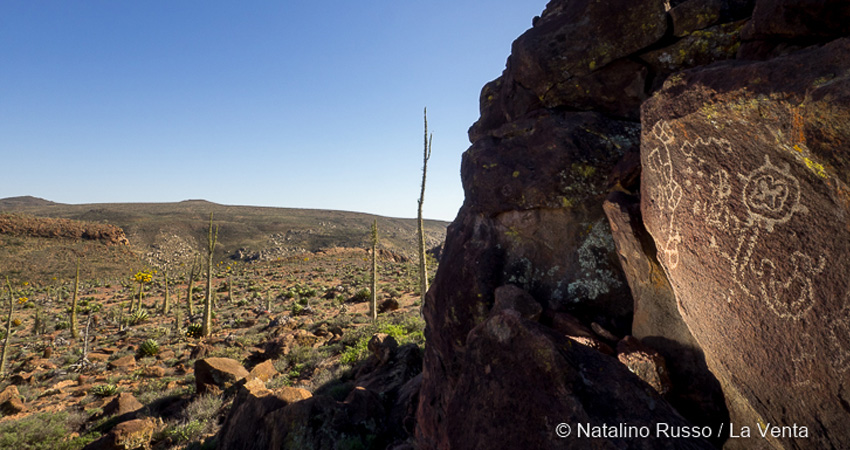
After another hour horseback, tied the animals for the steepness of the road, we continued on foot for another half hour. Beyond a bend of the river -so to speak because of water not even a shadow- finally we find petroglyphs, perhaps the most spectacular encountered until now. In a small space housed in the bend of the river, along a smooth slab of metamorphic rock, such as on a large blackboard, dozens of etchings and abstract designs, sculpted at the time when here the water flowed perennial and the inhabitants of these places hunted many species of wild animals then represented on cave paintings.
Completed the photographic documentation and acquired gps point we return to the camp, of course, with another 4 hours of horseback, sunburned, tired on shoulders but with great joy for the discovery. Thursday 19. Always horseback we move on the other side for a couple of hours, in the direction of a large rocky hill formed by huge landslides blocks of granite, where on top may be some evidence of rock art. The climb is not very easy, we had to look for the way inside of the landslide. Sometimes we can proceed quickly, sometimes we found ourselves in front of insurmountable obstacles. Anyway we arrived on top, and even there we found ourselves faced with a site Cochimi testimonies.
Within a large granite boulder excavated from atmospheric agents, such as in a large room, here stand the abstract paintings ocher colored. The place was definitely considered special, because the hill dominates the valley below. It could not be otherwise as it has fascinated us thousands of years after. Only negative note, during the filming of the climb to the site, a gust of wind has precipitated our drone, smashing it on the rocks. Fortunately we were able to put it into operation using spare parts taken from Italy. Francesco Lo Mastro In the following days were made other excursions penetrating in areas further south to an area called "the year of Borrero", where it was reported, by the local rancheros, a big cave with cave paintings. Traveling on horseback to get there: 9 hours!
Now Ciccio, Luca and Martino are on their way back. As soon as will return they will tell us even of these last days and finally we will see the photos.
So stay tuned! Support our adventure: Intermatica (Satellite phones), Ferrino (Clothing and outdoor equipment), Dolomite (Mountain footwear), Amphibious (Dry bags), Scurion (Led lighting systems), Tiberino (Dried foods ready to be cooked).

Read more: On the way home from Baja California

Starts the expedition of the Atacama Project

In the Atacama Desert are happening strange, exceptional things. First the Laskar volcano began to puff, threatening to resume its eruptive activity. Then "El Niño", with its rains, makes the desert bloom in a rainbow of colors, filling with fragrance the air around San Pedro. Could La Venta not be there? For months, in fact, the La Venta Association is organizing, together with the Cave Commission Eugenio Boegan of Trieste, an expedition in the Cordillera de la Sal. Are more than fifteen years that our friends from Trieste explore the caves in the salt in this remote piece of desert, and this year the forces and potential documentative La Venta joined speleologists from Trieste to put on photographs and films these wonders in salt.

While Triestines will continue their "salted" explorations in the largest caves in Chile, the La Venta team will follow their every step to better document these unique environments. In addition, the large group of scientists and explorers will conduct a series of surveys with laser scanner, as well as geological samplings, to try to understand better the mechanisms of formation and evolution of these caves in the salt, and especially their paleoclimatic and paleoenvironmental meaning. Studies, this ones initiates, always with the help of the friends of Trieste, by researchers at of the University of Bologna. The discovery of other karst systems in the salt, even greater than those studied eight years ago, will expand the knowledge of these caves with fast evolution. Jo De Waele
The expedition is sponsored by the Italian Speleological Society, and has the support of the Gruppo Servizi Topografici (GST snc) of Reggio Emilia (laser scanner), and of Intermatica (Satellite telephony), Ferrino (Clothing and outdoor equipment), Dolomite (mountain shoes), Amphibious (Dry bags), Scurion (lighting LEDs), Tiberino (freeze-dried foods ready to cook). Participate for La Venta: Jo De Waele, Riccardo De Luca, Umberto Del Vecchio, Marco Mecchia, Fulvio Iorio, Alfredo Brunetti, Laura Sanna, Andrea Cabras, Roberto Ferrara, Norma Damiano, Marco Vattano.

Read more: Starts the expedition of the Atacama Project

Little expedition problems

Our friends are now in a ranch called San Luis, in the little Puebo of Punta Prietas, hilly area with large granite boulders. The rock sites in the area they are exploring on foot, because this night there was a strong storm (because of Martino and Luca who carry floods with them?); they have arranged to the better sleeping under temporary shelters. In fact they do not have tends as in the desert it never rains. Almost... They say that the night is very cold, they had to buy blankets by locals to protect themselves.

Now the horses that were to be used are scattered in the soil of the local rancher, a vast territory. So last night the ranchers have returned in Punta Prieta, a few hours of off-road, to return with other horses. The pictures they have found belong to to the style Gran Mural, that Carlos had found in the North in the Sierra San Francisco and in another place in the south near the Mission San Volya, over 150 kilometers away. The pictures found then, in the Sierra de la Asamblea, allow to connect geographically this sites. The landscape is beautiful, the paintings are also made under the boulders and in the fractures, some even inside the rocks, which appears like large geodes. They did a lot of video recordings even with the drone and many photos. They should remain in this area 4-5 other days. Support our adventure: Intermatica (Satellite phones), Ferrino (Clothing and outdoor equipment), Dolomite (Mountain footwear), Amphibious (Dry bags), Scurion (Led lighting systems), Tiberino (Dried foods ready to be cooked).

Read more: Little expedition problems

Hunting for petroglyphs

We moved to the area "La Bocana", an interesting site of cave paintings may be of Cochimi culture. The whole area is also dotted by fossil remains of shells similar to the genus Turritella and strains of corals and coral, a clear sign that in the past the whole area was under the sea surface.
We arrived in a canyon with the presence of water known as El Palmarito. The place is very impressive for the stronger the contrast between the barren rocky landscape dotted with a thousand species of cactuses and the part in contact with water that has a deep green color with hundreds of lush green palm trees.
All around this explosion of life stands a rock wall mainly covered by petroglyphs. We are still not able to establish if this incisions are Cochimi or of an anterior culture.

Then we were in two spectacular locations in the desert.
The first called "Rancho Bachata", reached after an hour of hard off-road abandoned the trans peninsular. The second, always in the desert, is located in an area dotted with a myriad of huge granite rounded boulders and cactuses; in this place it opens in granite the "Cueva de la Langosta" (Cave of the lobster). At the "Rancho Bachata" We documented a raft of petroglyphs on the granite belonging to the culture Cochimì, prior and contemporary to the first Jesuit missions of the eighteenth century.
Instead in the area of Langosta there are interesting rock paintings, one of which resembles a lobster in a large geode granite excavated from the elements. These pictures are, at the moment, the most northern so far discovered of the kind "Great mural" dated 3 to 5,000 years ago. Now we go to the Sierra de la Asamblea, where on horseback will go up to 1600 meters to explore the mesas (highlands) and the canyons of the mountain. There we we stay the night outdoors for six or seven days.

Francesco Lo Mastro - La Venta Esplorazioni Geografiche. Support our adventure: Intermatica (Satellite phones), Ferrino (Clothing and outdoor equipment), Dolomite (Mountain footwear), Amphibious (Dry bags), Scurion (Led lighting systems), Tiberino (Dried foods ready to be cooked).

Read more: Hunting for petroglyphs

Questo sito o gli strumenti terzi da questo utilizzati si avvalgono di cookie necessari al funzionamento ed utili alle finalità illustrate nella cookie policy. Se vuoi saperne di più o negare il consenso a tutti o ad alcuni cookie, consulta la cookie policy. Cookie policy