Blog

Abyss of Cenote, in the heart of the Dolomites - Project Inside the Glaciers

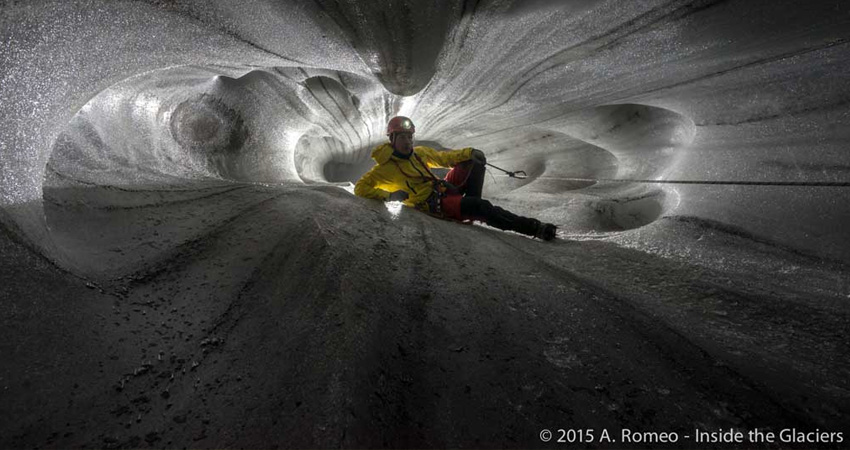
Last weekend, despite the difficult weather conditions, there was another chapter of the Project Inside the Glaciers, sponsored and supported by the Association La Venta, with the coordination of geologists and association members Alessio Romeo and Francesco Sauro. This time the theater of the research was the underground glacier abyss of Cenote, almost three thousand meters of altitude in the area of Cima Conturines, in the Park of Fosses Senes and Braies.

The exploration of the impressive abyss had already begun in 1994 by the Speleological Club Proteo of Vicenza. The cave was discovered following the sudden emptying of the large initial depression, then known as "Lake of the two forks." Finding the way down through the ice was not easy and in the following years the explorations were interrupted at about 70 meters depth due to difficult conditions for the summer melting of ice mass. Only in 2010, taking advantage of the first cold of autumn, it was possible to descend a huge inner shaft, only partially explored and documented. In this context it is placed the operation "Cenote 2015", with the involvement of the caving groups CS Proteus and G. S. Padovano, with the logistic support of La Venta and the scientific advice of the University of Bologna and Innsbruck. Despite the bad weather had settled about 70 cm of snow at high altitudes, forcing the expedition to wait two days, Saturday 17 it was possible to load on the mountain a field well-equipped, thanks to the professionalism of the pilots and operators of Elifriulia. Several teams then entered in the cave, to equip the cavity and to install a platform in the big shaft on which to put a laser scanner. The decisive moment was held between Sunday and Monday night, with the installation of temperature and pressure sensors, data loggers, scanning laser scanner salon and the final realization of a photographic reportage by photographer Robbie Shone and Alessio Romeo. The scientific results and 3D scanning will be processed in the coming weeks, but the results indicate that this cavity is one of the most important paleoclimate archives in the Dolomites. The laser scanner measure of the final room, dedicated to caver of the CSP Paolo Verico died in 2006, provided a maximum width of 120x36 m with a base area of 2,734 m2 and a volume of over 200,000 cubic meters. The total height of the abyss exceeds 200 meters, confirming that this is the largest underground room explored in the Dolomites. A general thank to those who participated and to the people who have worked with great effort and expenditure of time to the success of this operation: Daniela Barbieri, Matteo Barison, Alessandro Benazzato, Domenico Carletto, Samuela Dal Maso, Luca Dal Molin, Tono De Vivo, Filippo Felici, Mauro Lampo, Francesco Lo Mastro, Andrea Pirovano, Enzo Procopio, Alessio Romeo, Alberto Righetto, Francesco Sauro, Robbie Shone. Contributed to the success of the expedition the Proteus Speleological Club, the Speleological Group Padovano and the Group Caves Treviso. Also thanks to Carlo Poivesan for the construction of the aluminum structure for the laser scanner.
A heartfelt thanks to the Office Parks of the Autonomous Province of Bolzano for the authorization they granted us. We thank also the Commissione Centrale per la Speleologia CAI for support, the companyGruppo Servizi Topografici for the Laser Scanner, as well as the sponsors and patrons European Speleological Federation, Tiberino, Scurion, Intermatica, the French association Spélé’ice, the association La Venta, BEE1, Sovendi, the Italian Speleological Society and the National Mountain and Speleological Rescue Corp.

Read more: Abyss of Cenote, in the heart of the Dolomites - Project Inside the Glaciers

With a pinch of salt

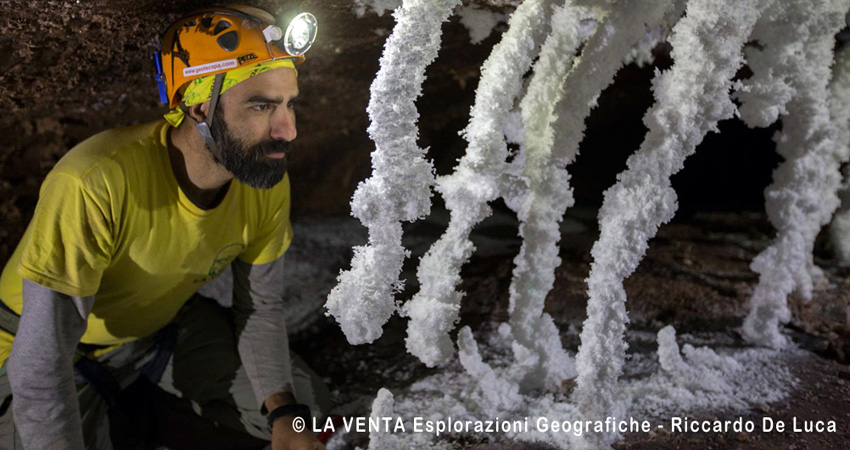
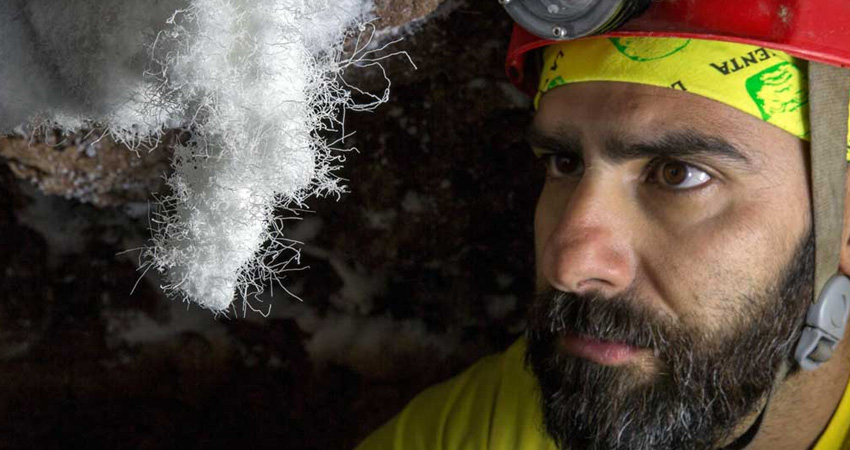
Tuesday, December 1, 2015. The Atacama expedition is almost over. Were a dozen days salty spent on a ridge of salt rock a few steps from San Pedro de Atacama, a tourist town at the foot of the volcano Licancabur. It was a glimpse of this lunar landscape, alien, in which develops cavities even kilometers long. Caves in this rock that at times seems glass, a few meters away snow. A rock that creaks when you put on your foot, but also as night falls, with disturbing snaps. Even in this region where it rains very rarely the karst process could act, leaving the cavers an underground landscape to explore. Our friends of the Commissione Grotte Eugenio Boegan of Trieste, with whom we have shared these days, were among the first to understand the exploration potential of this area. We, for our part, have tried to document the wonders of this land, with very special caves that look like those in gypsum, but with the concretions (of salt) aesthetically more beautiful. Look at our pictures to believe it! Not only concretions, but also many morphologies that can tell the story of these karst systems. The caves, in fact, can help to reconstruct weather events of the past. Each rain event, in fact, take away the salt in solution, and cause the transformation of the cave. Water of infiltration, when emerge in the cave, evaporate transforming the concretions already present. On the floors of the caves the fine sediment, still soaked with salt water, exudes and cause the formation of crusts of salt. With the Leica laser scanner, of the Gruppo Servizi Topografici (G.S.T. snc) of Reggio Emilia, we tried to "freeze" the typical morphology of these caves. With this high resolution topographic instrument and with an intense work we were able to survey a full cavity of 600 meters of development. This activity has been realized also thanks to the experience of one of the participants in the expedition, technician of the Institute of Bio-meteorology of thel CNR-IBIMET in Sassari. Several were the scientific sampling, of minerals and of organic remains trapped in the sediments of the cave. We hope to determine the secondary mineral phases in this particular underground environment, and to date some of the of the flood events that occurred in the past. The work ahead is still long, and the rewards certainly will be great. The expedition participants will certainly remember the starry nights on the plateau, the lunar landscapes outside, the subterranean crystalline world, the andean earthquake, the creaking of salt. It was not a dream, believe me. Jo De Waele All this has been possible thanks to our friends from Trieste, which made us as guides and companions for part of the expedition. Thanks to the Rincòn Escondido Coyo and its owners, Guglielmo and Catherine, who have provided assistance and accommodation with the traditional hospitality of the area. Also thanks to Manuel Cortes, person in charge of the Indigenous Association of the Valle de la Luna, and the staff who handle the Cordillera de la Sal that allowed us to do scientific research inside the Park area. We hope in the future to be able to work with them in a joint project of scientific popularization, environmental education and research in the salt caves of the Cordillera. The expedition is sponsored by the Italian Speleological Society, and has the support of the Gruppo Servizi Topografici (GST snc) of Reggio Emilia (laser scanner), and of Intermatica (Satellite telephony), Ferrino (Clothing and outdoor equipment), Dolomite (mountain shoes), Amphibious (Dry bags), Scurion (lighting LEDs), Tiberino (freeze-dried foods ready to cook). Participate for La Venta: Jo De Waele, Riccardo De Luca, Umberto Del Vecchio, Marco Mecchia, Fulvio Iorio, Alfredo Brunetti, Laura Sanna, Andrea Cabras, Roberto Ferrara, Norma Damiano, Marco Vattano.

Read more: With a pinch of salt

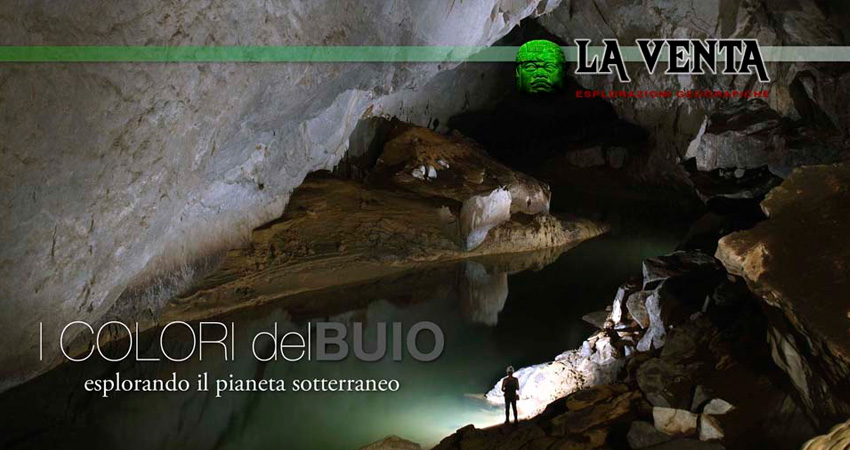
The Colors of the Dark on exhibition in Montebelluna

The exhibition "The Colors of the Dark" until 9 will be exposed in the ex Court of Montebelluna in collaboration with the Museum of Natural History and Archaeology of Montebelluna and the Municipal Administration of Montebelluna.

The opening hours are Saturday, Sunday, weekends and holidays from 10 am to 12.30 pm and from 3 pm to 7 pm.

The inauguration was held on Saturday, December 5th.

For information and reservations 0423300465. Or www.museomontebelluna.it.

Read more: The Colors of the Dark on exhibition in Montebelluna

Baja California. The final report.

Participated by La Venta: Carlos Lazcano, Franceso (Ciccio) Lo Mastro, Luca Massa, Martino Frova. Supported our adventure: Intermatica (Satellite phones), Ferrino (Clothing and outdoor equipment), Dolomite (Mountain footwear), Amphibious (Dry bags), Scurion (Led lighting systems), Tiberino (Dried foods ready to be cooked) In this last writing I would like to sum up what I said earlier and transmit in addition to the cold data, even emotions. After three days of traveling we returned to Italy. Now, thousands of kilometers away in our comfortable beds, we stare mesmerized at the ceiling thinking still in disbelief that we were there. In the eyes we still have the warm colors of the desert: the bright green of the cactus, the many shades of rocks, from black to dark red to ocher, the magical glitter of quartz sands and the soft profile of granite boulders that make this landscape unique. What we can say about the thousands of stars that accompanied our nights? City residents, those rare times when looks up to the sky only perceives an opaque veil of an indefinite black; here, raise your eyes, it means infinite wonder, an explosion of lights flickering and bluish to leave gaping, petrified, speechless. The desert, however, is not always as we imagine: a stereotype of hot sands, blistering heat and no sign of life. Sometimes it can be full of stones, cold at night and populated by cactus, rattlesnakes and scorpions; this is the desert of Baja California. Where we were? In the Valle de los Cirios 25,000 square kilometers of wilderness consisting of every species of cactus, including "lo que brincan", that just touching them throw their pieces that will stick in your meat or you will find them attached to shoes taking them for a walk without noticing. It is not that they are angry with us that are there to break that silence, but their somewhat violent way to propagate the species. Then there are the rattlesnakes, the same color as the ground, and scorpions, which fortunately here are not deadly but the sting is very painful; in short, we are in good company. We have made base in Cataviña, a few houses on Transpeninsular, the only expressways here, which crosses from north to south, the two states of Mexican California (Baja California and Baja California sur). By the way, the name "Californios" was given to the natives of these places by the early Jesuit missionaries who came here in the eighteenth mandated by the Spanish king Charles V. It derives from Califerne, an imaginary place mentioned in a story of the eighth century related to Charlemagne. From Cataviña then we moved in different directions always on reporting of "rancheros" of the place. We were at Bocana, supported in a shelter in the desert equipped by our friend and guide Nathan Velasco, a young enlightened and sensitive to the protection and preservation of this environment. We explored the site of Bachata, with its many petroglyphs; then we moved to the area of the Sierra de la Asamblea, a wilderness area with granite reliefs up to 1600m, totally unexplored and infinitely far from any sign of civilization. Here we suffered the cold at night and hot during the day, we were surprised by a violent night storm which wiped out our beliefs on the climate of the desert as well as dispersed our horses. The next days, the horses recovered and the long rides have rewarded of sacrifices by many findings, also important, as the site of "La Pintada", a stone slab along the rocky bed of a dry creek, a huge natural slate literally covered with petroglyphs, or as "The Pintadita 1", and "The Pintadita 2", real success of this expedition. Their rock paintings belong to the style Great Mural, what we hoped to find in these areas, just to connect the two other important sites like this: one many kilometers further north, in the Sierra San Francisco and the other in the south, in the Mission of San Borja. Very happy our friend and associate of La venta Carlos Lazcano, geologist, director of the Museum of History of Ensenada, creator of the project with the "Society of the Ancient California". The last few days have not gone very well, wandering in the immensity of the desert to check reports of elderly ranchers who had vague memories of drawings or colored spots on the rocks. Of these, one gave us a hope, by telling of a large cavity, which he called the "Painted Cave", where he said can stay in eleven horses (chissà poi perché proprio undici) and whose walls are covered with polychrome designs of all types. We tried to reach by jeep (on horseback it takes nine hours). We tried, but after three hours of bumps, dust, drilling and various concussions, as we were inventing the road on the moment and we risked stay forever there, we gave up. Unfortunately our time was over, but just this last objective will stimulate an expedition next year, maybe the whole on horseback. Meanwhile we can only dream... Francesco Lo Mastro – La Venta Esplorazioni Geografiche. Participated by La Venta: Carlos Lazcano, Franceso (Ciccio) Lo Mastro, Luca Massa, Martino Frova. We thanks the guides: Nathan Velasco, of Cataviña which offered important support and was the connection to locate guides in other regions of the Valle de los Cirios. Jose Sanchez and his son of the same name, who failed in the attempt to lead us to the Cueva Pintada. In the Sierra de la Asambleathe guides David Torres (son) and David Torres (father) who are familiar with these mountains. Supported our adventure: Intermatica (Satellite phones), Ferrino (Clothing and outdoor equipment), Dolomite (Mountain footwear), Amphibious (Dry bags), Scurion (Led lighting systems), Tiberino (Dried foods ready to be cooked).

Read more: Baja California. The final report.

Mars, or something very similar

Thursday, November 26, 2015. We just returned to the base camp of San Pedro de Atacama after four days in the salt of the Cordillera de la Sal with friends of the Commissione Grotte Eugenio Boegan (CGEB) of Trieste. The advanced camp was on the near plateau about 75 km from the small village of San Pedro, and the journey was for about 60 km on a track that cuts the arid plateau of the Llano de la Paciencia. The exploration area was at an altitude of 2580 m a.s.l. and was reached by jeep to the foot of the ridge, followed by a trek of 6 km with an initial steep slope and a vertical drop of 240 meters. Nothing for a trek in the Dolomites, but here in the hyperarid climate of Atacama has been a living hell. Each member of the expedition, from the northernmost of Trieste to the southernmost of Sicily, was loaded like a mule: aside from materials of camp and the food, to weigh is primarily the water. For four days in this salt desert we need at least 15 liters per person! It was also brought up the laser scanner Leica HDS7000 of the Company Gruppo Servizi Topografici (G.S.T. snc) of Reggio Emilia, that weighs as child of 7 years! Departure on foot at approximately 17.30 and most of the group has laboriously reached the advanced camp after five hours walking. The overload, combined with the afternoon heat, made us decide to take some of the load to the camp that evening,  while the remaining stopped on top of the initial height difference and reached the camp the next morning. Four members of La Venta have gone back and forth from the car to the plateau in the evening, improvising a bivouac at 2500 with the precious cargo, in the morning four more have reached the advanced camp to support them in the transportation of materials, while other three Triestines have done a full night turn to supplement their heavy exploration backpacks. It is ncredible as it may be large the thermal excursion here at this altitude: 50 ° C during the day just over 0 ° C at night! The advanced camp, located on the bottom of a narrow quebrada (gorge), is the relict of an ancient cave that preserve sometimes the ceiling, it is repaired with an average temperature of around 20 ° C. The first two days of camp in the heart of the plateau were dedicated to the photographic documentation of the large system of caves currently being explorated from friends of Trieste. They really found a beautiful underground world in the salt! Have been two days full of emotions, with over 10 hours of progression and numerous photographic stops: the belly of the Cordillera it is a crystalline world that enchants. The caves in the salt resemble those in gypsum, with waterfall shafts (also 50 meters deep!), meanders, paragenetical morphologies, and beautiful packages of river sediments. Concretions, rigorously of salt, are very white, fragile, mutable and of course recents. There are large stalactites and stalagmites, flows, floors that appears like made of white carasau bread, bubbles of salt (such as sweets made of the white part of the eggs), and thiny eccentrics and needles. The third and last day of work was reserved for the acquisition using the laser scanner to create a 3D reconstructions of some of the most suggestive parts of this salty world. A large room with a salt lake, a pit, a beautiful gallery in salt rock and the typical external karren fields, known as "penitentes", very appropriate name: try to walk on it! Now we have a day of rest, more than deserved, followed by three days of activities at the base of the Cordillera, in the Llano de la Paciencia, to visit and document the most important caves discovered by CGEB already some years ago. And we hope, with these caves, to be able to add other important elements in the understanding of the geological and climatic recent history of this hiperarid region. Jo De Waele The expedition is sponsored by the Italian Speleological Society, and has the support of the Gruppo Servizi Topografici (GST snc) of Reggio Emilia (laser scanner), and of Intermatica (Satellite telephony), Ferrino (Clothing and outdoor equipment), Dolomite (mountain shoes), Amphibious (Dry bags), Scurion (lighting LEDs), Tiberino (freeze-dried foods ready to cook). Participate for La Venta: Jo De Waele, Riccardo De Luca, Umberto Del Vecchio, Marco Mecchia, Fulvio Iorio, Alfredo Brunetti, Laura Sanna, Andrea Cabras, Roberto Ferrara, Norma Damiano, Marco Vattano.

Read more: Mars, or something very similar

Questo sito o gli strumenti terzi da questo utilizzati si avvalgono di cookie necessari al funzionamento ed utili alle finalità illustrate nella cookie policy. Se vuoi saperne di più o negare il consenso a tutti o ad alcuni cookie, consulta la cookie policy. Cookie policy