Blog

Juquila 2002

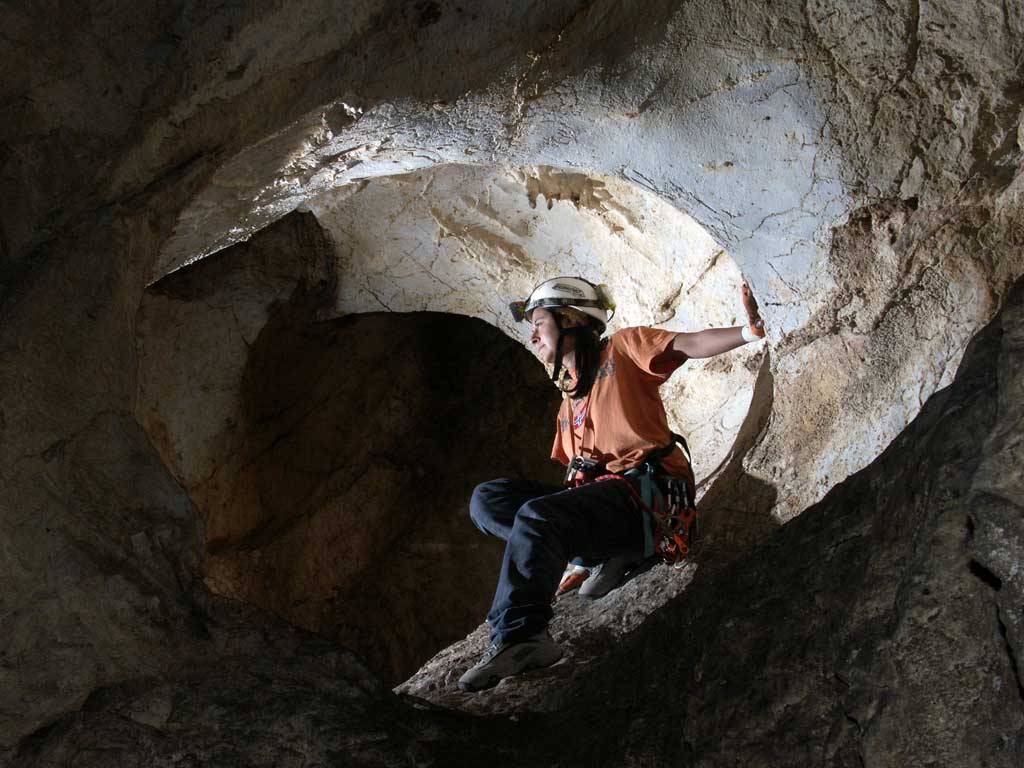
Expedition Juquila 2002”, Mexico JuquilaThe 2002 Juquila exploration put a real strain on men and equipment during the 10-day exploration of the Juquila Canyon.
The group was immediately divided into two teams for efficiency and security reasons: the first team started on the top of the canyon and had the task of exploring it while descending; the second team, thirty five kilometres down, had to equip a base camp and explore caves and springs on that side of the canyon before finally joining the others. They succeeded in the task but not without problems.
Apart from thorns and hot temperatures, constantly present in our expeditions, underestimating travelling times caused major difficulties. The area has turned out to be harder than we expected.
JuquilaThe canyon morphology, with its numerous landslides and drops, plus some small incidents (congestion, knee strain, broken superciliary arch with stitches, various bruises) considerably slowed down the descent of the first team. Nonetheless, the six members of the team speeded up, using the remaining stocks and managed to meet the rest of the group five days after the start, right on schedule.
The second team, approaching the canyon from the bottom, had many difficulties too. Despite using horses to transport equipment, carrying bags on our shoulders under the boiling sun, through thorns, rocks and a total lack of water, in nine hours we managed to reach a pass near the canyon. From there, with two more hours of extremely difficult descent (700 m drop in 800 m of development) the group finally reached the location where they set up the base camp. From here they carried out exploration and logistic activities.
This first exploration has allowed the development of a long-term research project in the area. Torna al progetto

Auyan Tepui 1996

Between February and March '96 a new expedition was carried on to complete the explorative work of the dephts of the Aonda platform (so called by the name of the main chasm, 360 meters deep and almost 600 long) and to further deepen the study of the speleogenetic mechanism in the quartzites. The expedition, however, was mainly aimed at the production of a 16mm documentary dedicated to these extraordinary environments and in particular to their caves and to the research carried out by La Venta Association. To the expedition, completed with the support of RAI (Italian public television), took part also the director Enrico Hendel and a team specialized in nature documentaries.
In parallel with the complex documentation task, which forced the team to transport heavy materials to the bottom of the Sima Aonda, were continued also some speleological explorations, reaching the bottom of the Fummifera Acque Pit, 350 meters deep, and the exploration of the Bloque Sima, then connected to the underground collector of the Sima Aonda.

Tepui 2009

The expedition, held in February 2009, had the goal to expand the cognitive framework of the karstic phenomenon in the quartz limestone of Venezuela, in particular regarding the hydrogeological, speleogenic and biospeleological point of view.
Specific target were the eastern offshoots of the vast Chiamanta Tepui, a range covering an area of nearly 1200 km2, topographically divided in several minor peaks, including Akopàn and Churì. Here, during a pre-expedition held in January 2008, we spotted several important cave entrances, some characterized by impressive resurgences on the walls.
The main problem we had to deal with was arriving to the cavities, which open on the high walls of the Akopàn Tepui, tackling challenging descents of almost 200 meters. It was essential using the helicopter to reach the top of the mountain, transporting one small autonomous team at a time.
During the expedition we collected an impressive photo and video documentation. For the first time in a speleological expedition we used the Inmarsat satellite system by Intermatica. This equipment allowed us to update, daily and in real time, a news page. Among the main explorative results, we explored the Akopàn-Dal Cin-Maripak system, with a 3,5 km development on huge active galleries.
During the expedition, the Venezuelan helicopter pilot Raul Arias spotted a large entrance in the highest plateaus of the Auyan Tepui. The cave was called Cueva Guacamaya and was explored a few weeks later by Arias, two Italian speleologists and a Venezuelan speleologist, Freddy Vergara.

Auyan Tepui 1993

In February ’93, thanks to almost 40 hours of work by helicopter, 2 tons of transferred equipment and complex radio communications, three groups worked for twenty days on the surface and in the depths of the large quartzite plateau of the Auyan Tepui. Works performed on the surface allowed us to draw detailed maps, thanks to modern satellite systems and detailed topographic mapping. We handled with several problems caused by the features of quartz arenite (abrasiveness, hardness on the surface and friability at depth) and with extreme climatic conditions (hard rainfall and sudden floods), nonetheless we were able to study one of the world’s deepest cave in this kind of rock: the Cueva del Rio Pintado (370 m deep, 2500 m long). Explorations of the Aonda and the Sima Churun platforms also produced unexpected results. Further on the data on the lenght of caves, we found clear evidence of the development of complex karst systems within quartzite and we were gaining a better understanding of the genesis of such phenomenon.
During the ‘93 Tepui expedition a documentary film was shot for the TV programme “Reportage” (Canale 5). The film obtained great success, thanks to its filming techniques and it’s amazing settings.

Tepui 2012

A serious accident occurred to the helicopter that should carry the members of the expedition on the Auyan Tepui, together with critical weather conditions, forced us to give up the original plan, including the exploration of new caves on the Auyan Tepui. After several days spent in the attempt to adhere to the original schedule, the group decided to take a short survey on the Roraima Tepui, the only one reachable by land with two intense days of walking. During the few days left, in prohibitive weather conditions, are made some surveys to detect new possible caves and are carried out some geological studies, aimed at enriching the knowledge framework of the Tepui and of the alteration processes the quartzite rocks are subjected to in these particular environments.

Auyan Tepui 2013

After the ill-fated expedition in 2012, in February 2013, 15 days of relatively stable weather allowed a team of speleologists from La Venta and Theraphosa Exploring Teams, to settle a camp in the eastern sector of the Auyan Tepui, on the edge of a large depression that revealed some entrances at the foot of the internal walls. Actually, hitting on the right entrance among that chaos of gigantic blocks was not so easy but, once detected, it revealed an unexpected world.
A few days of exploration on a tight schedule made it possible to explore and document almost 20 km of galleries, 15 km topographed, belonging to a vast labyrinth of horizontal galleries and amazing environments over a hundred meters wide and only a few meters high. A system crossed by several collectors, some of considerable flow (connected by inactive galleries with several entrances).
But what impresses most about this cave, called Imawarì Yeuta - the "House of Gods" in the Pemon Kamarakoto language - is not its size, but the incredible variety of speleothemes, consisting mainly of amorphous silica (opal), gypsum and iron oxides. The scientific interest of these formations is huge, because they are related to very peculiar geological and microclimatical conditions, that may occur only in caves of very slow evolution (several millions of years). Furthermore, the discovery of this cave contributes to the understanding of the speleogenetical processes in the quartzites (quartz sandstone) that, until a few years ago, were based on speculative models not fully validated by analytical data and physical-chemical models.

Questo sito o gli strumenti terzi da questo utilizzati si avvalgono di cookie necessari al funzionamento ed utili alle finalità illustrate nella cookie policy. Se vuoi saperne di più o negare il consenso a tutti o ad alcuni cookie, consulta la cookie policy. Cookie policy